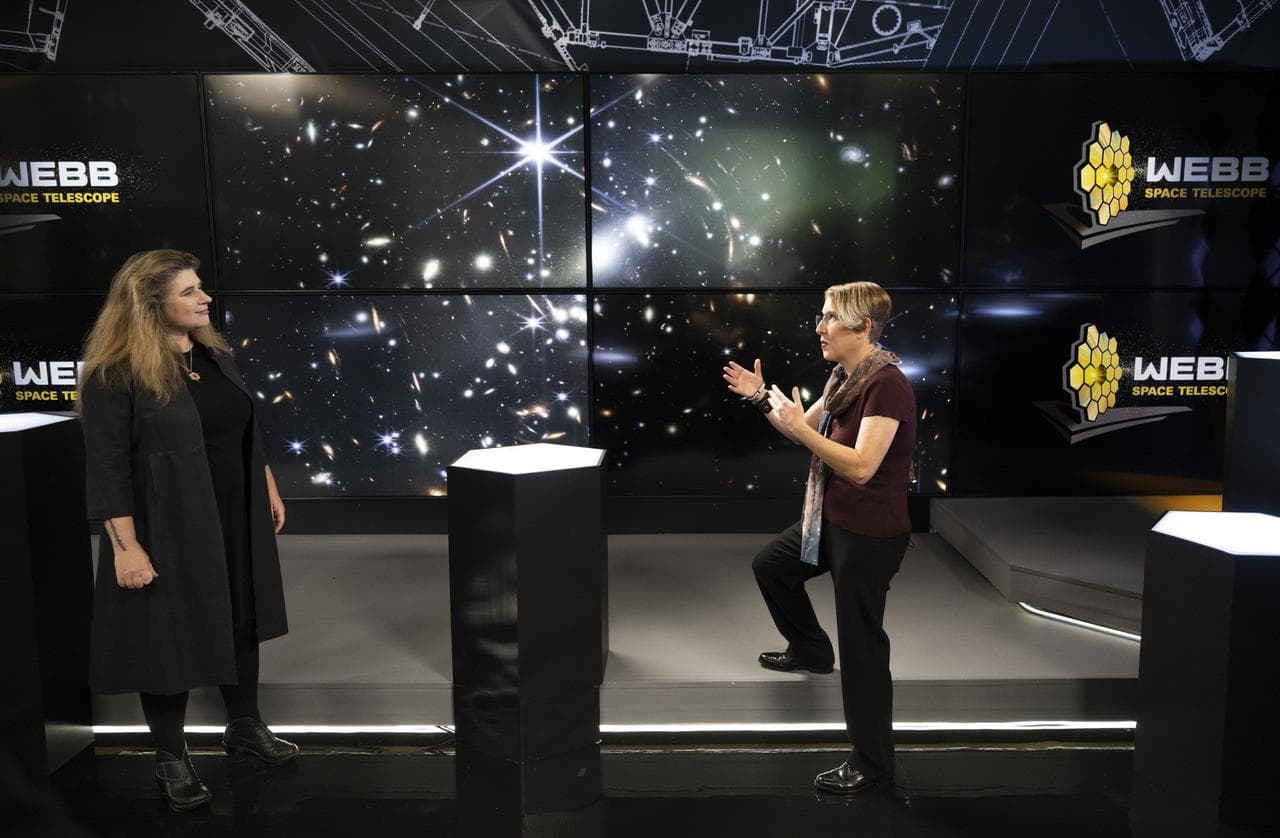
The James Webb Space Telescope (JWST) is a 6.5-meter infrared observatory parked at a gravitationally stable point called L2, about a million miles from Earth. Its gold-coated mirror is six times larger in area than Hubble's, and its instruments see infrared light that lets it look through dust clouds and back toward the first galaxies.
Webb launched on Christmas Day 2021 and unfolded itself in space over six months, a deployment with over 300 single points of failure that all worked. Its first images arrived in July 2022, and it has since found galaxies forming earlier and growing faster than models predicted.
Webb sees the universe as it was over 13 billion years ago, closer to the Big Bang than any telescope before it. It can also read the chemistry of atmospheres on planets orbiting other stars, the most direct search for life beyond Earth ever attempted.
Key Facts
- Launched
- December 25, 2021
- Location
- Sun-Earth L2, about 1 million miles from Earth
- Mirror
- 6.5 meters, 18 gold-coated segments
- Sees in
- Infrared (0.6 to 28.5 microns)
- Partners
- NASA, ESA, and the Canadian Space Agency
Timeline
December 2021
Launch aboard Ariane 5 from French Guiana
January 2022
Sunshield and mirror fully deployed; arrives at L2
July 2022
First full-color images released, including the deepest infrared view of the universe
Next up
Continued observation cycles; fuel supports 20+ years of science
Latest James Webb Space Telescope News
No recent stories for this mission. Browse the timeline above or all news on the homepage.
Facts last reviewed 2026-07-11. Official mission page: nasa.gov